


On 27 November 2026 we downloaded the public record of every theme in the WordPress.org directory: 15,506 of them. For each one we have its last update date, the date it was added, its active installs, its ratings, the WordPress and PHP versions it says it needs, and whether it is tagged as a block theme. This post is what that data shows.
We sell premium WordPress themes, but none of them is in the WordPress.org directory, so none of them is in this data. The numbers come straight from the directory's public API, the method and its limits are at the end, and the full dataset and scripts are on GitHub.
The short version
- 42% of listed themes haven't been updated in more than two years. Almost 2,000 haven't been touched in more than ten.
- Block themes are 46% of the themes added in 2026, up from 12% in 2022. Across the whole directory they are still only 15%.
- Ten themes hold half of all active installs. 61% of themes have fewer than 100.
- 70% of the themes updated this year declare a minimum PHP version below 7.4, the minimum WordPress 7.0 itself requires.
- Two thirds of themes have no ratings at all.
Four in ten themes haven't been updated in two years
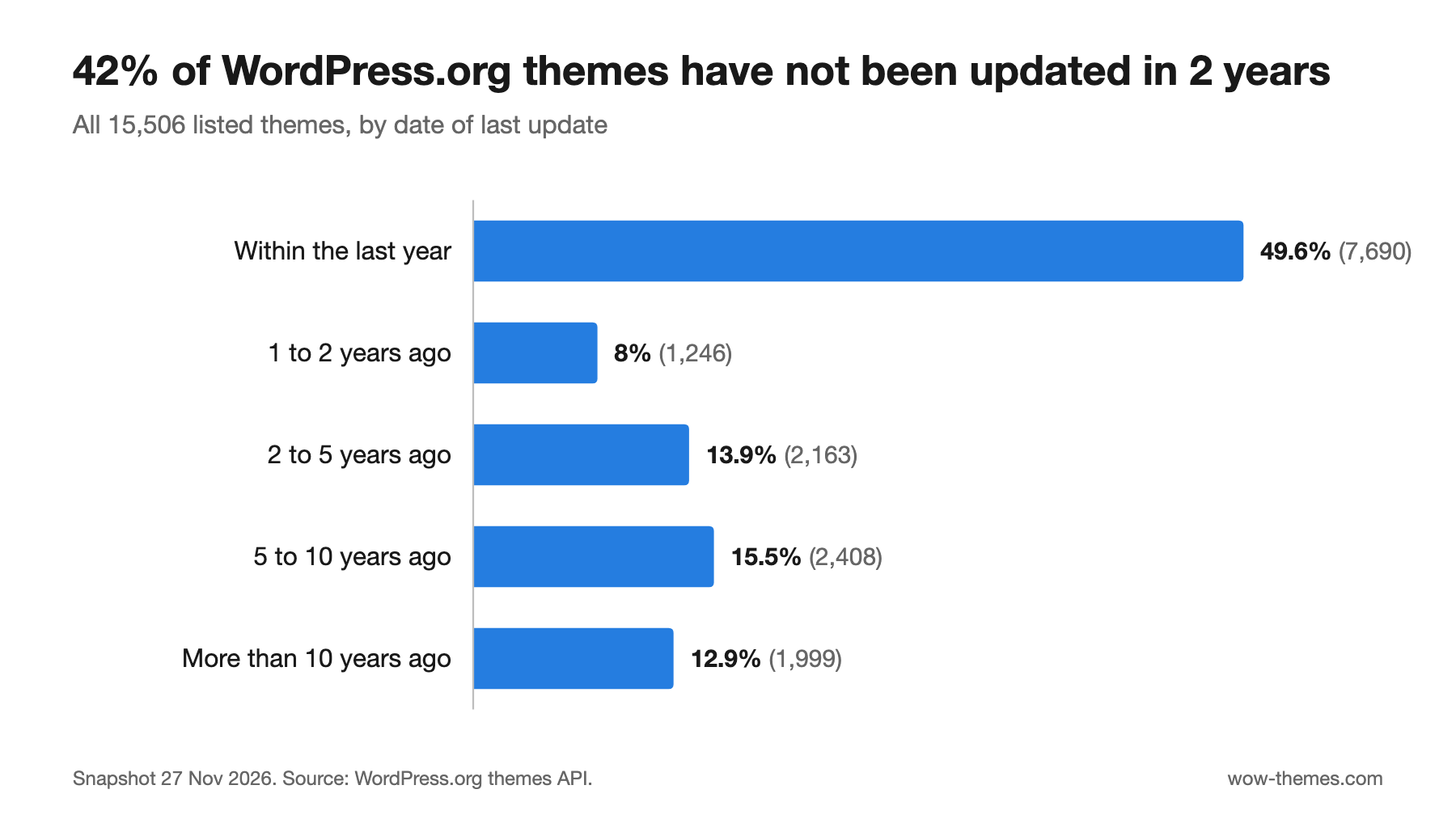
Half the directory (7,690 themes, 49.6%) was updated in the last twelve months. Another 1,246 (8%) were updated between one and two years ago. The remaining 6,570 (42.4%) haven't had an update for more than two years, and 1,999 of those were last updated more than ten years ago.
You won't see most of them when you browse. When we asked the API for its "popular" list, it returned 8,824 themes, every one of them updated within the past two years. The "newest" list returned all 15,506. So the stale themes are still there and still installable by name, but they mostly drop out of view.
They haven't dropped out of use, though. Themes with no update in two years still report at least 750,000 active installs between them, about 7% of the directory's total. 115 of them report 1,000 or more, and four report 10,000 or more. Those numbers are floors, because WordPress.org rounds install counts down.
An old theme isn't automatically broken. A simple theme can keep working for years. But a theme nobody maintains won't get fixes when WordPress changes or a security problem turns up, and that risk falls on the site owner.
Block themes are now almost half of what's new
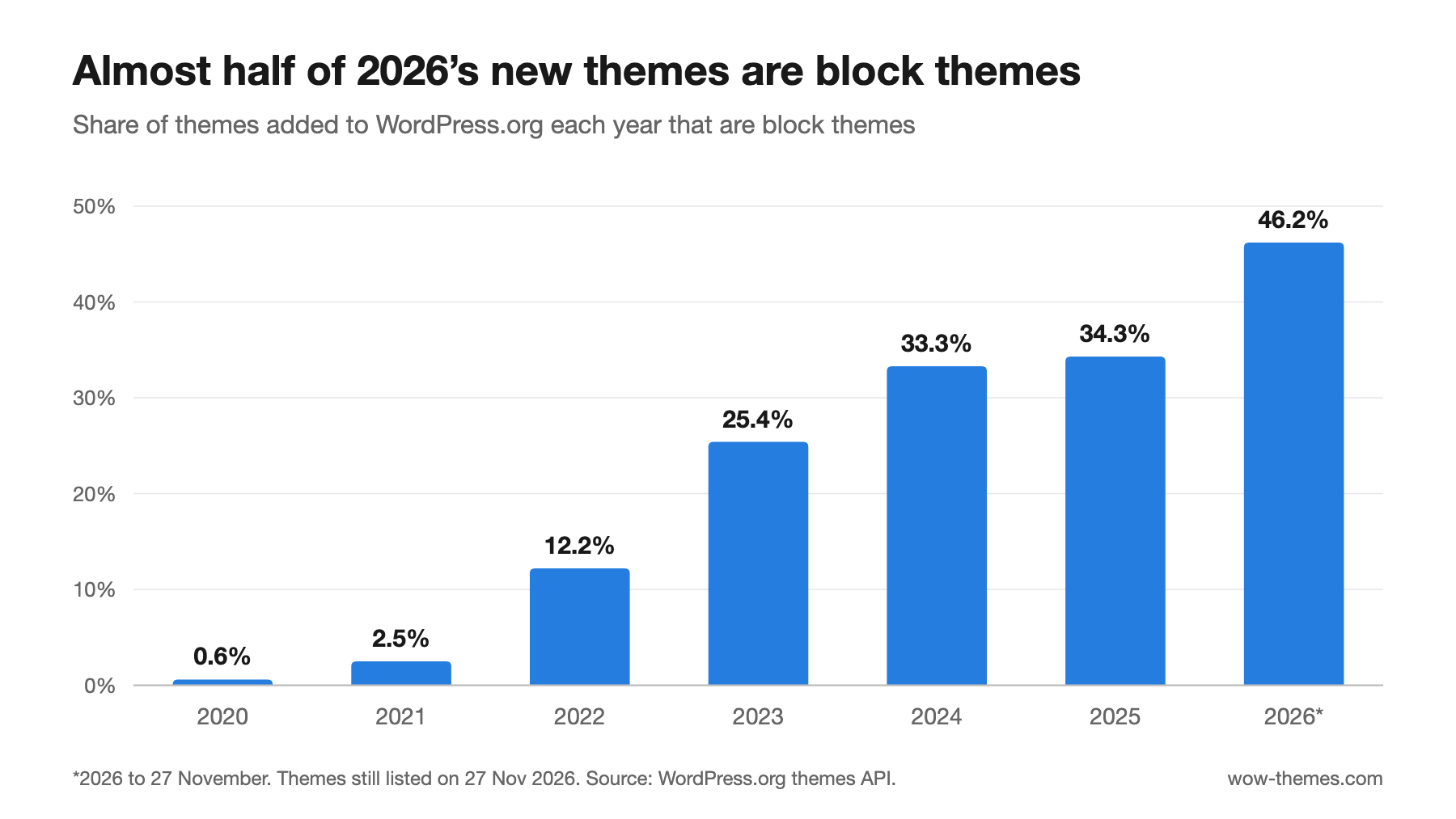
Block themes (the directory tags them "Block themes") let you edit the whole site, including headers and footers, in the WordPress site editor. They were rare until 2022. Of the themes added in 2020 and still listed, 0.6% are block themes. In 2022 it was 12.2%, in 2023 25.4%, in 2024 33.3% and in 2025 34.3%. So far in 2026 it's 46.2%, which is the biggest jump in three years.
Across the whole directory the picture is different, because older themes far outnumber new ones. 2,374 themes (15.3%) are block themes. Among the 8,936 themes updated in the last two years it's 22.5%.
Installs lag further behind. Of the 76 maintained themes with 10,000 or more active installs, nine are block themes, and two of those are WordPress's own default themes, Twenty Twenty-Five and Twenty Twenty-Four. Most large sites still run classic themes, often with a page builder on top.
If you're choosing a theme now, neither kind is wrong. A block theme suits you if you want to edit everything in WordPress itself. A classic theme with a builder may suit you better if your team already knows that builder.
Ten themes hold half of all installs
The directory's themes report about 11.4 million active installs in total, counted at the rounded-down figures the API gives. The ten biggest account for 49.9% of that:
| Theme | Active installs (rounded down) |
|---|---|
| Astra | 1,000,000+ |
| Hello Elementor | 1,000,000+ |
| Twenty Twenty-Five | 1,000,000+ |
| Twenty Twenty-Four | 500,000+ |
| GeneratePress | 500,000+ |
| Kadence | 500,000+ |
| OceanWP | 400,000+ |
| Twenty Seventeen | 300,000+ |
| Blocksy | 300,000+ |
| Neve | 200,000+ |
The top 100 hold 77.8%. At the other end, 9,473 themes (61.1%) report fewer than 100 installs, and 10,432 (67.3%) have never been rated by anyone.
This matters when you're judging a theme. Install counts mostly reward age and visibility, and most themes have too few ratings to tell you anything. For the long tail, the last update date and the support forum say more about a theme than either number.
Most themes declare a PHP floor WordPress has already left
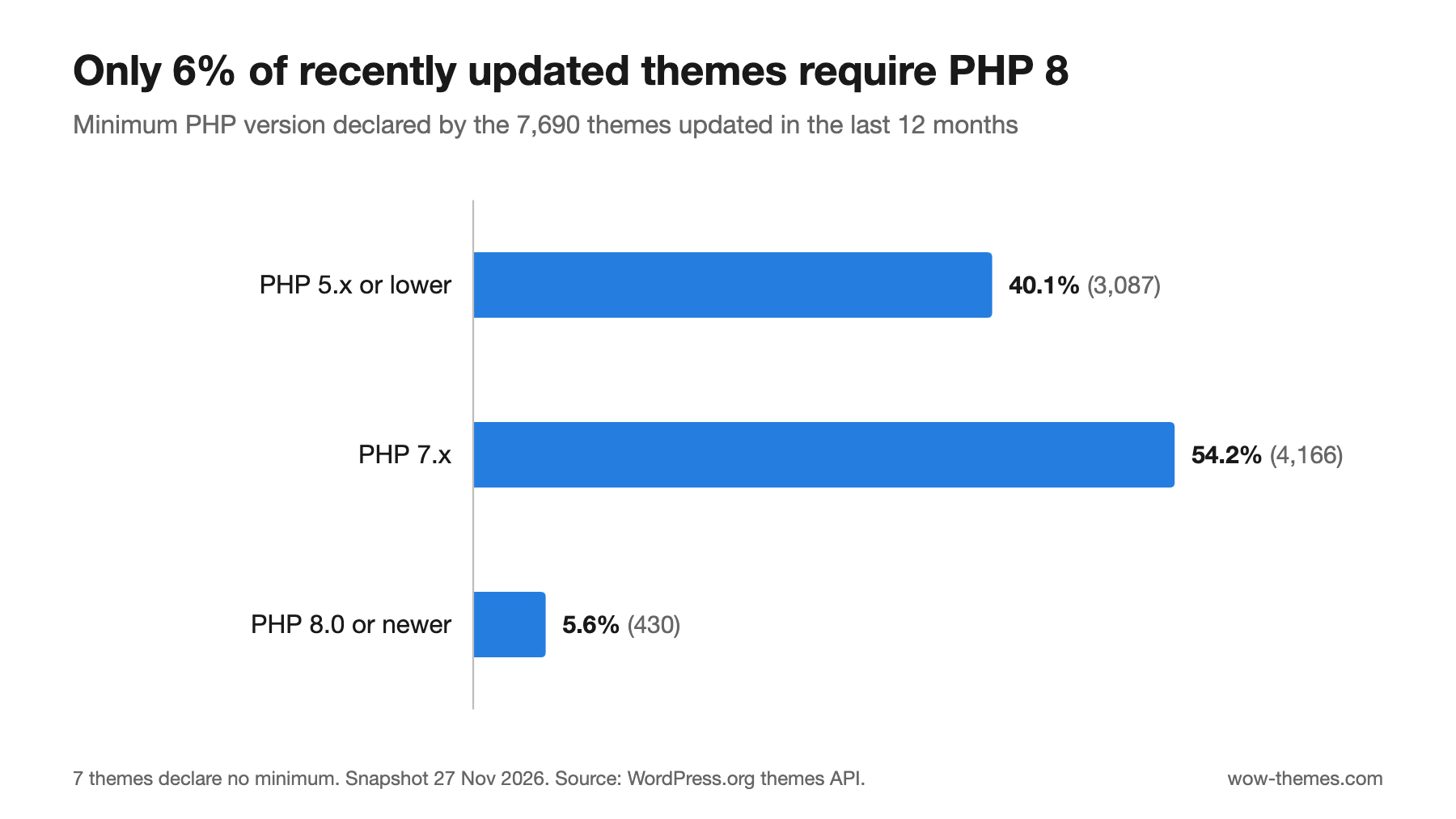
Every theme can declare the oldest PHP version it supports. We looked only at the 7,690 themes updated in the last twelve months, so these are maintained themes:
- 3,087 (40.1%) declare PHP 5.x or older. The single most common value is PHP 5.6.
- 4,166 (54.2%) declare a PHP 7 version.
- 430 (5.6%) declare PHP 8.0 or newer, and only 13 declare PHP 8.3 or newer.
WordPress 7.0 raised its own minimum to PHP 7.4, and the core team recommends PHP 8.3 or newer. 5,369 of these recently updated themes (69.8%) declare a minimum below 7.4.
Read that carefully. The "Requires PHP" line is a floor the author sets. It isn't a test result, and a theme that says PHP 5.6 may run perfectly well on PHP 8.4. What the number shows is that most authors haven't revisited the line, so it tells you little about which PHP versions a theme has actually been checked on. If your host runs a current PHP version, look at the theme's changelog or ask the author whether it has been tested on it.
What to take from this if you're picking a theme
- Check the last update date before anything else. Four in ten listed themes haven't had an update in two years.
- Treat install counts and star ratings as weak signals for smaller themes. Most themes have fewer than 100 installs and no ratings.
- Decide between block and classic based on how you'll edit, not on what's newest.
- Ask which PHP versions a theme has been tested on, rather than trusting the minimum it declares.
How we did it
- Source: the WordPress.org themes API (
api.wordpress.org/themes/info/1.2/, actionquery_themes, browsenew, 250 per page), downloaded on 27 November 2026. That gave 15,506 themes with no duplicates. - Fields used: last updated, date added, active installs, number of ratings, Requires at least (WordPress), Requires PHP and tags.
- Block themes are the themes carrying the directory's "Block themes" tag (full-site-editing), which authors set themselves.
- Active installs are rounded down by WordPress.org into steps (10, 20 … 100, 200 … 1,000,000+), so every install total here is a minimum.
- Year added counts only themes still listed on the snapshot date. Themes removed from the directory aren't in the data, so earlier years are undercounted.
- 2026 runs to 27 November.
- "Updated in the last year" means a last-updated date on or after 28 November 2025.
The directory changes every day, so these are the numbers for that date.
Get the data
The per-theme CSV, the script that downloads a fresh copy, and the script that recomputes every figure in this post are in our WordPress.org theme directory study repository on GitHub. You're welcome to use the data and the charts, including in your own articles. Please credit Wow Themes and link to this post or the repository. If you spot a mistake, open an issue there or tell us.
Disclosure: Wow Themes sells premium WordPress themes that aren't listed in the WordPress.org directory. The figures above come only from the directory's public API, read on 27 November 2026. The PHP requirements of WordPress itself come from the WordPress core team's announcements in 2026.

Written by
The people behind Wow Themes
The Wow Themes team builds and supports WordPress themes and a WooCommerce plugin. On the blog we write about building, running and securing websites: WordPress and WooCommerce, JavaScript, performance and the tools we use day to day.


Comments
No comments yet. Be the first to share your thoughts.